Every once in a while, I’ll tell somebody that I’m a libertarian and they will respond with something like, “Oh, you mean the Tea Party?” Which almost always makes me cringe, not because there is anything necessarily wrong with the Tea Party. I just think that the incorrect association gives people the wrong impression of what libertarians really believe. There are a wide variety of libertarians with many different views on various issues, and on some issues libertarians do agree with the Tea Party. However that does not make the two groups the same. I personally don’t even think that they are all that similar, but for some reason the two have become linked in many people’s minds.
The website TeaParty.org provides a list of what they call “15 Non-negotiable Core Beliefs.” I take non-negotiable, in this context, to mean that if you don’t agree with all 15 of these items, you are not in the Tea Party, at least according to them. Let’s look at all 15 and think about whether libertarians might agree.
1. Illegal aliens are here illegally. (NO) – Well, if we look past the obvious (and redundant) nature of this sentence that basically says that A = A, we can assume that they mean to say that if you have not followed every single one of the many immigration and naturalization laws that exist in this country that you are a criminal and that you should be arrested and deported. Conversely, one of the planks of the Libertarian Party Platform is
3.4 Free Trade and Migration
We support the removal of governmental impediments to free trade. Political freedom and escape from tyranny demand that individuals not be unreasonably constrained by government in the crossing of political boundaries. Economic freedom demands the unrestricted movement of human as well as financial capital across national borders. However, we support control over the entry into our country of foreign nationals who pose a credible threat to security, health or property.
Now I understand that a) The Libertarian Party does not speak for all libertarians (I’ll write another post at some point about Big ‘L’ versus small ‘l’.) And b) there is a great deal of gray area in determining who poses a credible threat. I would argue though that telling people who happen to live on the other side of a line somewhat arbitrarily drawn on a map hundreds of years ago that they cannot cross that line would constitute interfering with their ability to live their lives the way they choose. Also, their crossing of that political boundary, in and of itself, does not pose any threat to the freedom and choices of those already here. It seems to me that many of these rules exist based on fear of and prejudice against people who celebrate a different culture than those making the laws.
Let me be clear, you not liking someone or somebody competing with you for assets does not constitute an infringement on your liberties so long as they aren’t committing violence, theft, or fraud. Competition is not the sort of threat I’m talking about here. Furthermore,in my opinion, that holds regardless of where a person was born or where they most recently lived.
2. Pro-domestic employment is indispensable. (NO) This is also addressed by item 3.4 in the Libertarian Party Platform. Restrictions to free trade imposed by governments, including restrictions on labor, infringe upon the liberties of both the employer and the employee. If two parties freely and openly agree to a trade that they each feel is beneficial to them, then they should be allowed to trade, regardless of lines on a map.
Now, that having been said, if individuals or companies choose to not do business with someone who sends their labor dollars overseas, that is also their right. I experience a smaller version of this all of the time. I live in a small, rural, mountain town in Montana. Many people in town, me included, choose to buy most of our goods in town or as nearby as possible. I would rather those dollars stay here in town where they are used and enjoyed by my friends and neighbors. I do this even though I might be able to save a significant amount of money by shopping in the bigger city about an hour away. However, if someone passed a law and said that it was illegal for me to buy things from across the county border. I’d find that absurd and I’d be pretty angry. Why would one boundary be different than another in this matter.
3. A strong military is essential. (No) This one becomes a little bit of a gray area, but not too much. Libertarians do believe in providing a strong national defense, but when we say defense we mean defense. I believe that when the Tea Party speaks of a strong military, they are referring to the ability to bomb, invade, and otherwise attack other countries, to impose our will upon them. The United States has an active military presence in about 150 of the 196 countries around the world. That is far more than just defense. Most libertarians agree that the government spends too much taxpayer money on the military.
Also, when you spend that much money on having that many troops and that much equipment deployed all over the world, people tend to think that we need to use that military in order to get our money’s worth. That may explain why it seems like we have been in the invasion of the month club for the last several years.
4. Special interests must be eliminated. (Maybe) This item is a little vague, and there is a bunch of gray area here depending on what you mean by special interests. If you’re talking about sweetheart deals, crony capitalism, corporate subsidies, backroom deals and other such things. Then absolutely they need to be eliminated. In order for free markets to really work, they need to really be free. Once you get government helping one portion of the market, the playing field is tilted and it is no longer a free market.
If conversely, by special interests, you are referring to lobbyists and campaign finance, then this gets more complex. Personally, I don’t think that corporations or even individuals should be allowed to make donations of unlimited funds to a campaign. I think it skews the democratic process in favor of the wealthy. However, that needs to be balanced with freedom of expression and the freedom to try to convince others to follow your viewpoint. I struggle with this one. I don’t know just how to properly strike that balance. I know I don’t generally agree with any person or group trying to get special treatment or an exemption to the rules, but people need to be able to advocate for the rules they believe are right. They should also be allowed to pay someone to advocate on their behalf. The official Libertarian Party Platform does not see as much gray area as I do on this one. The party platform stance is the “repeal of all laws which restrict voluntary financing of election campaigns. ” Fortunately you don’t always have to completely agree with your party on every issue.
5. Gun ownership is sacred. (YES) I don’t think I would use the word sacred, but libertarians do support 2nd amendment rights. We believe that we have a right to defend ourselves, our families, and our property from whatever threat may exist, and we believe that we have the right to responsibly use firearms to that end.
6. Government must be downsized. (YES) This is pretty much inherent to the libertarian idea of “as little government as is necessary.” The current government, especially at the federal and state levels, is too large.
7. The national budget must be balanced.(YES) This seems pretty self evident to many people, except when it comes to figuring out what to cut or where to find more money. The fiscally responsible part of libertarianism refers to not buying things we can’t afford and not spending money that we don’t have. We spend too much on government programs that are inefficient and/or inappropriate and we don’t have enough money to pay for it all. And raising taxes is not the answer.
8. Deficit spending must end. (YES) Didn’t we just talk about this?
9. Bailout and stimulus plans are illegal. (Yes) Again, I don’t agree with the choice of terms here, because I’m not aware of anything that explicitly makes these ideas illegal. However, most libertarians would agree that these sorts of programs are not a great idea. Bailouts are generally driven by the idea of some business being “too big to fail.” That if that business were allowed to go out of business it would have too much of a negative impact on the rest of the economy and would bring down the economy as a whole. There may be some truth to this idea in the short run, but I believe that it has a worse effect in the long run. Not allowing a company to fail when it has… well … failed, provides all of the wrong incentives in the future. If companies believe that they will be bailed out, there is less incentive to make good business decisions. It becomes acceptable to over-pay some people and it makes sense to make risky investments in ideas that may not be fully thought out. Why shouldn’t they, if they drive the company into the ground, the government will make everything all better. It also doubles down on old companies with old ideas and old technologies. It discourages the innovation and fresh ideas that the free market tends to encourage. Sometimes companies fail because the world no longer needs or wants what it is selling.
Economic stimulus plans pretty much always operate by manipulating one or more of the 4 portions of the economy that make up the Gross Domestic Product (GDP, one of the most common macro economic indicators): consumption, investment, government expenditure, and net exports. We Americans like what we like. We want cheap electronics. We want fresh fruits and vegetables even in the dead of winter. We want all sorts of things that must be produced all over the world. For these reasons we have been importing more than we export for some time. Net exports is almost always negative in the United States. Investment is pretty hard to have a real impact on with any short term government program. That leaves government spending and consumption. The biggest economic stimulus plans we have seen in this country recently have mostly been in one of 2 forms. 1)Programs like the American Recovery and Reinvestment Act of 2009 (ARRA) increase government spending which injects money into the economy. This can have a short-term positive effect on the economy. This is the theory behind the old myth that war is good for the economy. War always means increased government spending. Unfortunately the only ways to pay for increased government spending is increased taxes (which has a negative impact on consumption and investment) or deficit spending (which has a long term negative impact on consumption, investment, and government spending because so much money is needed for debt service.)
The other popular form of economic stimulus has been 2)Direct refunds back to taxpayers. The theory here is that extra money in people’s hands will go into increased consumption and / or investment. The problems with this sort of program are that much of that money often goes into savings rather than consumption or investment. These programs also cost a great deal to calculate, print, and distribute those checks. Why not just reduce the taxes in the first place and reduce the costs of the IRS processing all of those funds even once rather than handling them twice?
10. Reducing personal income taxes is a must. (Yes) Excessive taxes infringe upon liberty. Every dollar that I must pay in taxes is one less dollar for me to spend in whatever way that I choose to be best for me.
11. Reducing business income taxes is mandatory. (Yes) This is basically the same as number 10 and the same argument applies.
12. Political offices must be available to average citizens. (Yes, but how?) I agree that elected offices should be accessible to anyone who has the desire and the backing. There are a couple of challenges though. Political offices require a great deal of time and effort to fulfill properly. Knowing what every bill or resolution says, never mind what it all means and what impacts it might have, can be like a full time job. Even in local government, elected officials find that they have great demands on their time. So in many places elected positions that are volunteer in nature can only be filled by those who have copious extra free time to devote to the position without compensation. Often that means only the independently wealthy and the retired. These are certainly sections of the population that deserve representation in government, but I’m not sure that they necessarily represent most people or that they are “average citizens.”
This then leads us to professional politicians and political sponsorship which, in turn, brings us back to the gray areas that I talked about earlier in issue number 4. I’ll share more thoughts on this in a separate post.
13. Intrusive government must be stopped. (Yes) It seems like every day we hear about more ways in which the government is violating the rights of US citizens. Limitations on first amendment rights are more and more obvious. NSA surveillance, domestic drone missions, and other provisions of the Patriot Act have made a mockery of our fourth amendment rights against illegal search and seizure. Fifth and Sixth Amendment rights are diminished as due process of law is marginalized and eminent domain is abused. When government officials swear to uphold and defend the Constitution of the United States, they need to remember that includes the Bill of Rights as well as the other amendments.
14. English as our core language is required. (NO) Most people in the US do speak English, but there is no reason why it should be required. You should have the freedom to speak whatever language(s) you choose. If you can’t speak the same language as someone else, you might not be able to do business with them, but that is your choice as much as it is theirs. I took 5 years of Spanish classes between high school and college and I could have maintained a reasonably sufficient proficiency in it. However, through a series of choices, I allowed that skill to lapse. I wish I hadn’t because I’ve had numerous occasions in which I would have liked to have been able to speak with certain people who only spoke Spanish. I see the failure of communication as falling as much on me as on them. With self-governance comes a level of self-reliance. Why should I expect them to learn my language? If I want to interact with them, I can give myself that power by learning their language. And if I choose not to give myself that power, there may be some people with whom I will be unable to interact. With the freedom of choices come the consequences of our decisions.
15. Traditional family values are encouraged. (NO!!!) This is the big one. This, to me, is where tea partiers and libertarians really separate. The problem with the above statement is that it makes an awful lot of assumptions about morality. Whose traditions? Whose family values? Different cultural backgrounds have a wide variety of traditional family values.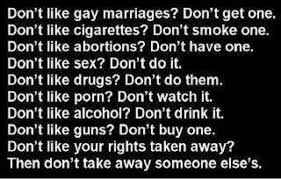 The point of libertarianism is that everybody should be able to choose however they want to live their own lives. We believe it is not our place to restrict others based on their sexual preference, their gender identity, or their marital status. Nor is it right to tell someone else how they should think, feel, pray, or contemplate the eternal. To me values and morals are very personal things and as long as you aren’t harming anyone else, live and let live.
So of these 15 items, the 2 groups seem to disagree on 5 of them, a full third. If you take into account that items 7 and 8 are essentially the same thing and items 10 and 11 are basically the 2 sides of the same coin, then we disagree on 5 out of 13 issues or almost 40% of the issues that have been identified as central and non-negotiable to the Tea Party. Granted that does mean that we do agree on more than 60% of these issues, but these Tea Party statements all strike me as Republican stances. I have said before that libertarians agree with Republicans on some issues and with Democrats on other issues. (I like to think of it as taking the best ideas from each of the 2 major parties and throwing out the rest, but that’s my bias.)
So does that mean that libertarians are 60% Republican and 40% Democrat? Certainly not. This is how one libertarian feels about one rather specific list of issues. On a different list of issues I might agree with the Democrats on 75%. Or another libertarian might agree with the Republicans on this list 70% of the time as opposed to my 60%. The point is rather that I think there are some important and substantial differences between libertarians and the Tea Party.
So then why do so many people think the 2 movements are the same thing? I think it is largely because some people who I would classify as Tea Partiers call themselves libertarians. In most of these cases I would exclude them from what I classify as a libertarian because of item #15 on the list above, determining what values by which others should live. Rand Paul is a prime example. He speaks about building fences and securing our borders. He argues in favor of traditional Christian values on abortion and marriage. I know I am kicking a hornet’s nest by challenging the libertarian status of a member of the Paul family, but to me, he does not fulfill the socially liberal aspect of libertarianism. I think he is a better candidate than most modern Republicans, but that’s a discussion for a different time.
As always, these are my opinions. I do not claim to speak for all libertarians. In this blog, I do not claim to speak for anyone but myself. I’d like to know what you think. Do you agree that there is a substantial difference between libertarians and the Tea Party? Are libertarians better off associating with the Tea Party or distancing themselves from it? Do you consider Rand Paul a libertarian? Please leave your thoughts in the comments below or suggest a topic for a future post. Remember that I believe that everybody is entitled to their opinions, so I ask (actually I insist) that all comments remain polite and respectful. If you enjoyed what I had to say please give this post a like. (Even if you don’t necessarily agree.) If you want to see future posts, please be sure to subscribe to receive updates by email.





 A Moderate Libertarian